Sunday, 13 March 2022

Ukraine: the urgent need for rational resolutions rather than irrational escalations


Incendiary calls for all-out military responses to Russia's illegal invasion of Ukraine are mounting at an alarming rate.


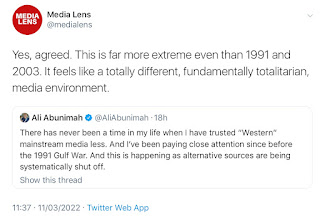
We are now witnessing unprecedented levels of media propaganda and war hysteria.

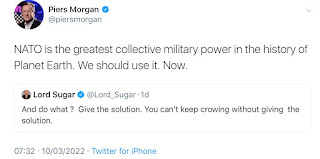
Piers Morgan has intensified the war cries by invoking the 'now-or-never' deployment of 'mighty' NATO.


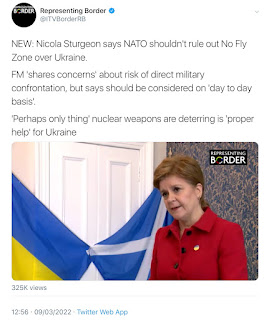
Nicola Sturgeon has even surpassed Boris Johnson, as well as Biden's own clear message of non-NATO intervention into Ukraine, in urging that a 'no-fly zone' - an effective declaration of war on Russia, and start of World War III - be kept as an available option.


Watching, listening or reading almost any form of 'mainstream' news right now renders it all but impossible to gain anything but a one-sided view of events, and slanted opinion.


The BBC is an unconstrained UK/NATO propaganda platform, even its 'once-reputed' World Service now reduced to "straight-up stenography." 


Those seeking more 'thoughtful' coverage and analysis from outlets like Channel 4 News are also being dismally failed, its presenters registering the same Western-toned jingoism, its reports still safely boundaried and dutifully framed. 


With this has come the most authoritarian purge ever seen across social media, overseen by US-backed big-tech.


Google/YouTube have announced a complete global ban on all 'pro-Russian' outlets and content. This includes the worldwide removal of RT and Sputnik, the taking down of Abby Martin's entire Breaking the Set archive, and attempts to curtail the landmark film Ukraine on Fire by esteemed director Oliver Stone.


Every facet of Russian life, history and culture is now being attacked and cancelled - even Tolstoy and Tchaikovsky


Joseph Massad captures it well:

"The Russophobic campaign straddles the entire western political spectrum, and it is fully endorsed by western liberals and cultural elites... [Having] unified western conservatives and liberals in the US and Europe, I feel confident in saying that most likely if you scratch many a white liberal, you will find a white supremacist Cold Warrior."

And, of course, there is no shortage of Euro-backed provocative propaganda coming directly out of Kiev.


This is a war being waged on our very capacity to see, understand and think about the war being waged in Ukraine itself.


'Just make it stop, deal with the problem, find a solution' 


People, understandably, consumed by this relentless barrage of news and harsh images, the terrible killing, the human suffering, will say: 'it must just stop, people are dying, something must be done, what's the solution?


Yet how often have we come to hear these kind of plaintive cries and questions? 


Recall 'the problems' of Afghanistan, Iraq, Libya and Syria. Remember the framing and the anxious, notably liberal interventionist, calls: 'what do we do' about the 'threats' coming from these places - all of which turned out not to be about actual threats, but pretexts for Western invasion, aggression and expansion. 


The framing over Ukraine as a 'problem' for the West and its peoples is no different. Powerful forces unleash war and conflict, with no apparent ways out, and the public are left wondering how to 'find solutions' to it all.


The 'task' is rendered all the more perplexing because, failed by the media, people have little or no understanding of how things actually get to these critical points. But they're encouraged, nonetheless, to 'partake' in the same 'problem-solving' narrative.


The sequence and presentation of 'the problem' in this case runs, essentially, thus: the West/NATO create a gathering, dangerous problem with its expansionist push on Ukraine and Russia's front line; after years of signalled discontent, Russia finally responds to the problem by massing troops along its border; the West/NATO ignore this final warning, foreclosing any immediate chance of off-setting the problem, seeing, instead, ways of exploiting the self-made problem by goading Russia into a bogged-down invasion; Russia duly invades, either miscalculating this entrapment, or calculating that it has no other answer to the problem; the West/NATO are now in full narrative control, presenting Putin as the problem, and urging public support for their further militaristic response to it; duly framed, a deceived and gaslit public embrace this version of the problem, seeing adherence to the West/NATO as their own dutiful way of serving to resolve it; having been effectively excluded from all the key context and information allowing actual comprehension of the problem, they either succumb to the available wall of establishment/media 'information', or resign themselves to never knowing or understanding how the problem ever came about; both types of public compliance/acceptance suit the Western/NATO narrative in its ongoing misrepresentation and cultivation of the problem.


It's very easy from this point to excite and harness an already heightened public into the most dangerous and irrational forms of war-talk. 


And, of course, that righteous narrative is ever-mindful to avoid any indictment or denigration of 'our own' criminal elite. 


It's still truly sobering to think how, in this febrile atmosphere, Putin can be so massively demonised, while Blair, Bush and their coteries, responsible for illegal invasions and much greater crimes against humanity, are being protected and feted.  


Likewise, how easily popularised memes like 'mad Putin' and the 'new Hitler' come to displace coherent readings of the situation. Indeed, how readily informed analysts themselves become excluded from view and damned as 'Putin apologists'.


In resisting such compliance, and in real problem-solving vein, it's vital that we do seek out the contextual background to such crises.


In short, there can be no meaningful resolution without meaningful understanding of what needs to be resolved.


Rationality and resolutions 


And this requires us, with rational mind, to confront the fundamental problem driving the war in Ukraine: US/NATO.  


Rather than a body that should have been consigned to Cold War history following the fall of the Soviet Union and end of the Warsaw Pact, NATO has grown to become the world's most dangerous force in raising the bar for big state confrontation, 'hot-war' and the prospect of nuclear annihilation. 


The rational response would be to dismantle NATO, returning us to the immediate post-Cold War openings and possibilities of peaceful dividends. 


But that level of rationality, in the service of reducing tensions and creating stability, cannot be contemplated by Western elites, and the corporate-military interests it serves. We're locked, instead, into the intractable doctrine of zero-sum Western militarism, neoliberal capitalist expansion and ultimate imperialist control of the globe. 


In this scenario, Russia and China, now encircled by US/NATO bases, will see no rational sense in ever risking incursions into its perceived spheres of influence, its very security - just as the US responded in 1962 over the Cuban missiles crisis. 


All of which goes some way to explaining why, even against any rational reading of how Russia may now likely get bogged down in an Afghanistan-like quagmire, it still opted to invade Ukraine.


Assuming the likely continuation of NATO aggression by its US/Western sponsors, and conversant Russian resistance to it, the next best level of hope is for some rational form of concession and accommodation. 


At the very minimum, this, for Russia, would require an authentic declaration of neutrality for Ukraine, and some form of independent/autonomous status for the Russian-identifying Donbas region, including Crimea. 


Minsk 2 has now been rendered obsolete by the invasion. But it still contains the fundamentals of any new agreement.  


With strong internal support from the populations of Donetsk and Luhansk, Moscow's formal recognition of them, and now obvious military presence, Russia has these areas firmly within its geopolitical and economic sphere. What, after Ukraine's relentless, Western-armed/trained, and failed, assault on them for eight years is to be gained now from its ongoing war there?


Formal relinquishing of any NATO membership would also remove the more existential issue of Russia's border security. Like the rational acceptance of 'lost' land, this will require realistic acceptance of Russia's 'higher' security concerns.  


So, what would Ukraine get in return from any such accord? 


Most immediately, it would offer some chance of a Russian withdrawal. It would save countless lives. It might allow the return of fleeing refugees to possibly still-intact homes. It could see Ukrainians securing and re-shaping their state. It may encourage the building of a new political landscape which understands the precarious nature of its position between two nuclear superpowers, planning accordingly for independent, peaceful relations. It would also avoid Ukraine having to expend the 2 per cent plus of its GDP, as expected of NATO membership, on wasteful and dangerous militarism.


Any process of de-Nazification in Ukraine, as insisted on by Russia, is a longer-term task. And, of course, it comes with recognition of such dark forces in other countries. But Ukraine could make meaningful efforts to acknowledge its own deep harbouring of Nazi elements and ideology. 


Only three states voted against a recent UN resolution calling for Ukraine to end the glorification of Nazis and neo-Nazi forces within its country: tiny Palau, the US, and Ukraine itself. Both Washington and Kiev could make a useful start in rescinding that decision. 


Zelensky: leader or led?


The question, ultimately, here for Ukrainians is whether it is rational to sue now for peace, save lives, protect homes, live in a secured, neutral state and relinquish futile claims to already-taken provinces; or to continue in devastating war-mode, sacrificing thousands more lives, greater infrastructure and the chance of regaining their country.  


But why, many will say, should Ukraine succumb? Isn't this just the surrendering of sovereignty and caving to Russian force? Perhaps. Yet why should patriotic ideals and spurious claims to land supersede more rational accommodations and the protection of human life? 


Russia can only take Kiev if it 'razes it to the ground', Zelensky proclaims. Is he, himself, being grounded here in asserting this 'ground-zero' option? 


It should be remembered that Zelensky was elected largely on a promise to resolve the fighting in Donbas, and to secure some kind of nominal peace with Russia. Yet, in pandering to right-nationalist pressures not to implement the articles of Minsk 2, thus continuing the conflict, Zelensky is really in no moral position to talk about sacrificing any more people or places. 


In truth, Zelensky in office has been driven by a more familiar set of base interests and political motivations, in playing the populist field, cultivating capitalist oligarchs and reaching out to a ready array of US patrons; just as Putin represents and manages his own matrix of capitalist oligarchy. 


And, as all the high-stake power-play and elite competition manifests into conflict and war, it's the civilian and poorest classes in both countries who, as ever, become the real sacrificial fodder. 


It's remarkable how Zelensky has been cast as a figure of heroic resistance, rather than a Western-promoted pawn who has potentially gambled his country away. How readily he waxes Churchillian to Western political audiences. How eagerly they cheerlead him on to war. Wouldn’t the real heroic act here be to resist the rhetoric, and lofty encouragement, in the quest for real peace, life and stability?  


It's highly questionable whether Zelensky has the true political stature and integrity to make that crucial call. The tragedy is that it will take so much more death and destruction before Ukraine comes to this inevitable point anyway. 


Just treatment and resolutions for all


Nor do we ever hear such invocations of sovereign rights and choices for other attacked states, such as the long-suffering peoples of Iraq, Afghanistan, Libya, Syria and Yemen, staggering catastrophes of the West's, NATO's and their allies' making, populations decimated, their states and rights violated, their plight all but ignored by a Western-centred media. 


Any country, any invaded or occupied people, has a legally-defined right to resist such aggression. Ukraine certainly does. 


But so do occupied, besieged and suffering Palestinians - even where that right is always more difficult to enact.  


Where is the 'international community's' lofty support for them? Where is the offer of mass weaponry. Where are the blanket sanctions? Where is the emergency aid for those relentlessly bombed and trapped in the prison of Gaza? And why are those Palestinians resisting their oppressors forever labelled 'terrorists', while Ukrainian resistance is deemed patriotic heroism?


All aggressions should be condemned, the perpetrators of all human suffering through state-inflicted violence brought to account. 


And it is beholden on honest media and observers of all state violence to provide consistent, open and searching accounts of how such violence comes to be visited on all those peoples. 


As the killing across Ukraine intensifies, taking the lives of Ukrainians and Russians alike, any hope of a meaningful outcome to the conflict can only emerge from proper understanding and presentation of its core causes. 


Further to previous suggested reading and viewing, much can be learned from this latest listing of informed explanations, analyses and efforts towards some hopeful, rational resolution. 


Oliver Stone (director) film: Ukraine on Fire


Jonathan Cook: The West's Hands in Ukraine Are As Bloody as Putin's


Patrick Lawrence: The Casualties of Empire


Chris Hedges: Worthy and Unworthy Victims


Jonathan Steele: Ukraine's Grim Choice: Why Surrender May be the Honorable Option


Margaret Kimberley: In Praise of "Whataboutism"


Navigating our Humanity: Ilan Pappé on the Four Lessons from Ukraine


Joe Glenton: Former NATO Soldier's Alternative Guide to the War on Ukraine


Matt Kennard and Mark Curtis: Ukrainian neo-Nazis Pictured with UK-made Rocket Launchers


Alan MacLeod: Its Different, They’re White: Media Ignore Conflicts Around the World to Focus on Ukraine


Alan MacLeod: A short history of the United States deliberately bombing hospitals [Thread]


Declassified UK, editorial: Eight Dangers of the New Cold War


James Kelly: Let us resolve that this crisis must be the last time humanity ever faces a nuclear war scare. That means total nuclear disarmament 


Jonathon Shafi: The SNP and the No Fly Zone


Communist Party of Britain: Statement on Ukraine


Joseph Massad: Western rush to ban everything Russian, from cats to Dostoevsky, smacks of totalitarianism


Clare Daly: Ukraine War Speech


Monday, 7 March 2022

Fuelling the Ukraine crisis: the perils of liberal militarism

“Of course the people don’t want war. But after all, it’s the leaders of the country who determine the policy, and it’s always a simple matter to drag the people along whether it’s a democracy, a fascist dictatorship, or a parliament, or a communist dictatorship. Voice or no voice, the people can always be brought to the bidding of the leaders. That is easy. All you have to do is tell them they are being attacked, and denounce the pacifists for lack of patriotism, and exposing the country to greater danger.”

Leading Nazi, Hermann Goering, speaking privately to Gustave Gilbert, US intelligence officer and psychologist, during the Nuremberg trials.

As war in Ukraine deepens, calls across the West for punishing responses and vengeful attacks grow by the day. The invasion of Ukraine, we are warned, is an 'attack on all of Europe', and on Western 'civilization' itself. 

Rather than working with rational intent to de-escalate the crisis, the US/UK/EU/NATO is rushing every piece of armoury at hand into Ukraine. 


The dangers and folly of this policy could not be more stark. Not only does it prolong warfare, with multiple more deaths and casualties, but the contagion of ugly war-talk renders any possible negotiation and resolution evermore difficult.


Western 'military analysts', safe in academic offices and media studios, are 'biting at the bit' to 'take-on' Putin. While grudgingly accepting, for the moment, the perilous risks of a so-called 'no-fly-zone', some urge that it must still be 'kept on the table'.


Indeed, American public support for what would, effectively, be a declaration of war on Russia, a World War III, is already alarmingly highUS demonstrators are marching for the same 'close the sky' policy, the actual dark consequences of such still, apparently, hidden behind these benign-sounding terms. 


Ramping-up the rhetoric are a range of media-feted parliamentarians, such as Tobias Ellwood, MP, and member of the MoD-funded 77th Brigade, effectively calling for war with Russia.


Yet the most dangerously siren voices for retaliatory action, escalation and open war are coming not from the usual right-wing quarters, but from the forces of 'respectable' liberal militarism. 


The implicit and increasingly explicit case for war is being propagated with no apparent caution or restraint across the popular press and airwaves.


The New York Times is even prepared to peddle already-exposed fake news in service of the 'Ukranian cause'. 


In further weapons-porn hype, the Daily Record proclaims: 'Deadly RAF ‘beast mode’ fighter jets that will ‘make Putin sweat’ arrives in UK'


The BBC’s Jeremy Vine - past guest speaker to the arms industry - used his own daytime TV show to impart this astonishing message to a caller:

“Bill, the brutal reality is, if you put on a uniform for Putin and you go and fight his war, you probably deserve to die, don’t you? That’s life! That’s the way it goes.” 

The BBC's own refusal to censure Vine, as they certainly would others, for this appalling comment speaks volumes about the current atmosphere of jingoistic war fervour.


Putin ‘dead or in the dock’, vented Neil Mackay, in another callous and ignorant rant on the ‘imperative’ need to ‘break the Russian people’. Incredibly, Mackay seemed completely unconstrained and unconcerned about advocating the actual breaking of international humanitarian law in punishing an entire people.   


Derogatory 'Mad Vlad' sloganising offers no useful language either, in understanding the roots of this crisis, or, more pressingly, how we might ever find a constructive dialogue for negotiating a way out of it.


And look no further than the lamentable posturings of Paul Mason to see how vociferously the ‘no-alternative-to-militarism’ narrative is being propagated by the 'cruise-missile left', particularly against the no-war left.


As with Iraq, Afghanistan, Libya and elsewhere, the crisis in Ukraine has shown how public support for war is garnered. States make the calls. Governments marshall the forces. Armchair generals ratchet-up the fear. Right-wing hawks and 'think-tanks' ‘hype and authenticate’ their claims. But it takes the essential voices of liberal militarists to normalise and popularise the case for escalations and war. 


The ‘international rules-based order’ may be the motif for self-appointed US global policing, invasion and control, but it’s the 'moral' liberal evocation of it in rationalising ‘militarist solutions’ that’s so crucial in selling it to the public. 


The liberal ‘mainstream’ media, in particular, has not only been vital in disguising the roots of the conflict in Ukraine - while waxing in racist tones on the tragedy of war in 'civilized' Europe - but in hyper-charging us in readiness for another ‘necessary intervention’.  


Amid the corporate media-led mass hysteria now in support of 'hallowed' Ukraine, you will not hear of that state's relentless shelling and killing of the Russian-identifying people of Donbass. You won't hear of President Zelensky's oligarch banking connections, and anti-democratic acts, including the closing down of three media stations last year. And you certainly won't hear of Ukraine's neo-Nazi militarism, incorporation of it's neo-Nazi Azov Battalion, and its deep regard for Nazi-collaborating figures like Stepan Bandera.


Across the BBC and ‘mainstream’ media, what should be the legitimate reporting of suffering citizens has turned into a blatant exercise in heart-tugging propaganda. And, of course, the scale and intensity of such outpourings has never been matched in the reporting of human suffering in Yemen, Palestine, Fallujah and other places of Western led/supported war and carnage.   


The siren amplifications of liberal militarist talking points and imagery are not only obscuring and deflecting such state violence, but, as over Ukraine, fuelling the case for further violence. 


Why did it come to this critical point, and who benefits?


It should be noted, firstly, that addressing the 'blame issue' is not some academic or wasteful abstraction. It matters considerably, both as a means of locating the essence of the problem, and any possible resolution of it.


For Chomsky:

"It’s easy to understand why those suffering from the crime may regard it as an unacceptable indulgence to inquire into why it happened and whether it could have been avoided. Understandable, but mistaken. If we want to respond to the tragedy in ways that will help the victims, and avert still worse catastrophes that loom ahead, it is wise, and necessary, to learn as much as we can about what went wrong and how the course could have been corrected."

In considering the causes of the present conflict, John Mearsheimer, leading figure of the Realist school of international relations - and no obvious leftist - is studious in his analysis and unequivocal in his conclusions: the West, in its relentless policy of eastward NATO expansion, is "principally to blame" for the current crisis in Ukraine. It's decision to "double-down" with the same militaristic responses, has, Mearsheimer asserts, been a further act of disastrous proportions. 


His projections: Ukraine, played and sacrificed as a pawn state by the West, will be wrecked; the possibility of a neutral Ukraine is lost for the foreseeable future; Russia, with much more of an existential stake in this war, will persevere and 'win'; and Putin himself, backed by a resilient-minded Russian public, may weather the political storm and survive.


One needn’t subscribe to Mearsheimer’s particular field of scholarship to recognise the import of his reading, or the plausibility of his suggestions.


Even with other possible turns, we can be clear here on the basics: core responsibility for this situation rests with the West; the crisis was avoidable; and the fallouts will see considerable human suffering for many years to come. 


What of the West's own apparent 'calculus'?


Biden made explicit statements days before the invasion, assuring the world that it was "imminent"; days away. 


Many, including most of the left, disbelieved this call, having, quite rationally, come to suspect anything being peddled by 'intelligence sources'. 


But, of course, it does now appear that Biden was stating an actual truth. The invasion did happen. And on the nominal timeline Biden claimed. 


Which begs an even more critical question: having such pre-knowledge of the invasion, what did the US and other Western powers actually do to help prevent it? 


Indeed, it goes further than this. We now have credible claims that the invasion was decided upon some two months beforehand. 


So if Biden and US intelligence knew of such Russian plans to invade at this much earlier point, as seems likely - and while supposed ‘representations’ to Moscow were being made by Macron and others - why was no more substantive diplomatic effort made to offset it? 


Some welcome, if still token, 'mainstream' questioning of the dominant narrative here has emerged, asking whether the US/West failed to see the coming crisis and act responsibly:

“…the abundance of evidence that NATO was a sustained source of anxiety for Moscow raises the question of whether the United States’ strategic posture was not just imprudent but negligent.” 

Was the US, having walked Ukraine down this cul-de-sac, with no immediate prospect of joining the NATO club, so averse to losing face with Moscow that it just kept ramping-up the threats, hoping to call Putin’s military bluff? A credible interpretation.    


But what if US readings and motives were more mendacious than simply negligent or hubristic? 


Did the US deliberately stand back and allow the invasion to happen, encouraging Russia into a trap? 


Did Biden and the intelligence agencies calculate that the US, NATO and their backers would stand to benefit from the fallout, with Putin completely maligned by the 'international community', and Russia severely weakened? 


This mirrors the same 'lead them on', 'let them bleed' strategy followed by the US over the Soviet Union's invasion and prolonged occupation of Afghanistan. 


For now, we can but speculate. As with Afghanistan and elsewhere, clear evidence of such may yet unravel. But what we have, for the moment, is damning enough. 


For Chomsky: 

"The fact is, to be honest, that we do not know why the decision was made, even whether it was made by Putin alone or by the Russian Security Council in which he plays the leading role. There are, however, some things we do know with fair confidence, including the record reviewed in some detail by those just cited, who have been in high places on the inside of the planning system. In brief, the crisis has been brewing for 25 years as the U.S. contemptuously rejected Russian security concerns, in particular their clear red lines: Georgia and especially Ukraine. There is good reason to believe that this tragedy could have been avoided, until the last minute."

As Chomsky notes, we may never learn just how misguidedly or deceitfully the West configured the situation. 


But it is clearly evident which particular forces stand to gain from the present outcome. 


NATO is now massively 'validated' and strengthened. Finland, having lived in neutral peace on Russia's border, for the first time now contemplates joining NATO. Sweden is making similar overtures, professing the same 'anxious need' to be ‘safely’ within NATO's orbit.


In other such responses, Scotland’s SNP administration and camp followers are now even more deeply-wedded to Atlanticist policies and full NATO membership. Under independence - if Sturgeon ever decides to seek it - we are also now likely to see a shift on nuclear arms and stealthy abandonment of 'sacrosanct pledges' to close Faslane.


Again, as Mearsheimer and others show, none of this offers the remotest prospect of peace and stability. 


Rather than recognising the increasing insecurity and dangers of NATO expansion, we're seeing the precise reversal of what's needed: the urgent abandonment of NATO - a volatile threat and relic of the Cold War - and emergency removal of nuclear weapons.


Meanwhile, existing  NATO member countries will now plunge even more of their GDP resources into arms spending. And, of course, the corporate weapons suppliers are revelling in their stock market surge and new orders.


Clearly, the West has vested interests in spreading fear and insecurity. Like a mafiosa-expanding business, it seeks political, economic and military control of the entire 'neighbourhood'. NATO is, in effect, a protection racket.


Real diplomacy, solidarity and routes to peace


Imagine, instead, if the vast energies of states, governments, international bodies, think-tanks, academics, policy-makers, media outlets and other civil institutions were harnessed towards real, dedicated diplomacy, finding compromises and seeking peace, instead of militarism, arms spending and war. 


The term ‘diplomacy’ itself has now been rendered meaningless, a token posture. True, vigilant diplomacy, working quietly, efficiently and unconstrained behind the scenes, could have settled these issues decades ago, avoiding what we’re now seeing in Ukraine. 


Likewise, from Starmer's NATO-pledging Labour to the rabid war-peddling Guardian, an entire field of liberal politics, media and culture is now completely in lock-step to the ideologies and prescriptions of militarist 'resolutions'.  


Predictably, we even have menacing efforts now to censor and cancel Mearsheimer for daring to analyse the conflict in Ukraine and offer a critical assessment. 


Goering gave a chilling insight on how easy it is for leaders and states to lead people to war. But today, the rush to war is predicated much more vitally on the persuasive energies of the liberal class in service to those powers. 


The ease with which the populace is seduced into hateful denigration of the 'other', pitch-fork responses and all-out war owes so much more to what's being propagated as righteous liberal militarism. 


Any serious acts of human support, in averting further death and suffering in Ukraine, and laying some ultimate groundwork for stability and peace, must involve standing in resolute resistance to these dangerous forces. 

___________________


Update: 7 March 2022


Extract from Bryce Green: Calling Russia’s Attack ‘Unprovoked’ Lets US Off the Hook

‘The strategic case for risking war’


“It’s impossible to say for sure why the Biden administration took an approach that increased the likelihood of war, but one Wall Street Journal piece from last month may offer some insight.


The Journal (12/22/21) published an op-ed from John Deni, a researcher at the Atlantic Council, a think tank funded by the US and allied governments that serves as NATO’s de facto brain trust. The piece was provocatively headlined “The Strategic Case for Risking War in Ukraine.” Deni’s argument was that the West should refuse to negotiate with Russia, because either potential outcome would be beneficial to US interests.


If Putin backed down without a deal, it would be a major embarrassment. He would lose face and stature, domestically and on the world stage.


But Putin going to war would also be good for the US, the Journal op-ed argued. Firstly,  it would give NATO more legitimacy by “forg[ing] an even stronger anti-Russian consensus across Europe.” Secondly, a major attack would trigger “another round of more debilitating economic sanctions,” weakening the Russian economy and its ability to compete with the US for global influence. Thirdly, an invasion is “likely to spawn a guerrilla war” that would “sap the strength and morale of Russia’s military while undercutting Mr. Putin’s domestic popularity and reducing Russia’s soft power globally.”


In short, we have part of the NATO brain trust advocating risking Ukrainian civilians as pawns in the US’s quest to strengthen its position around the world.”